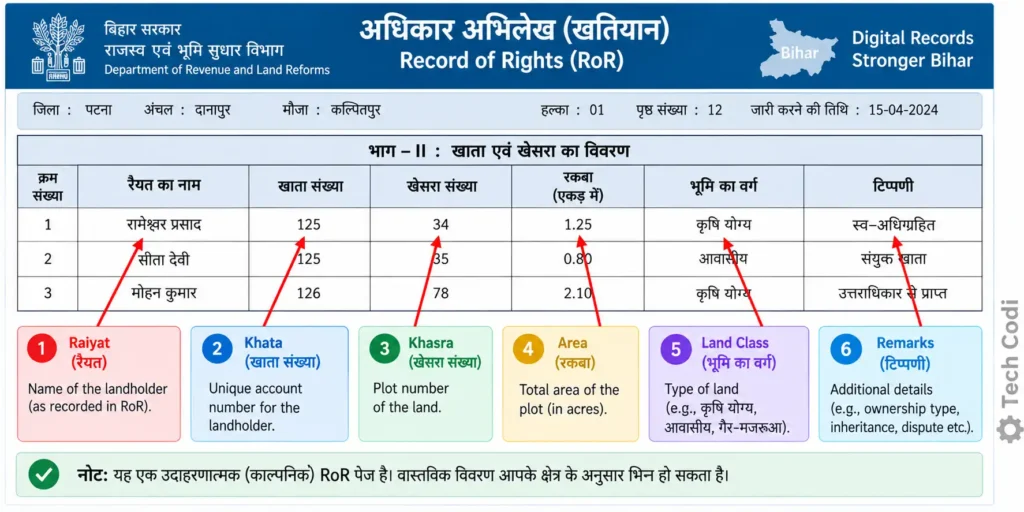
A Record of Rights, commonly shortened to RoR, is a survey-based land record that identifies land parcels and the people or interests recorded against them at a particular point in time. In Bihar, the term is closely associated with khatiyan. It may contain the raiyat’s name, khata and khasra numbers, area, land classification, rent assessment, and remarks about recorded rights.
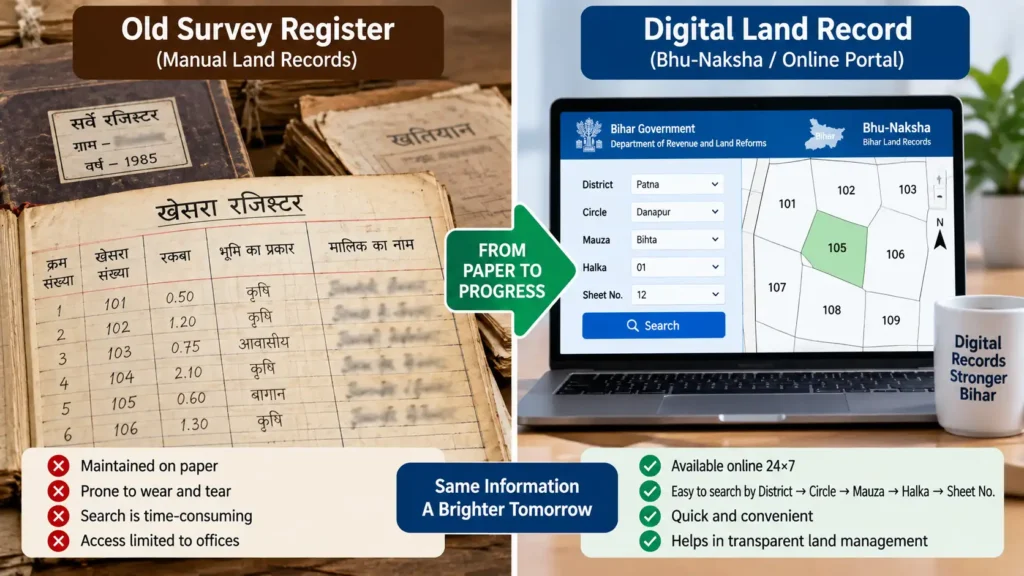
RoR is valuable because it establishes historical context. It does not automatically answer who owns the land today. A parcel may have been sold, gifted, inherited, partitioned, acquired, or affected by a later order after the survey was completed.
Information commonly found in RoR Bihar
- Name of the recorded raiyat or interested person
- Khata number
- Khasra or plot number
- Recorded area
- Land class or nature
- Rent or revenue assessment
- Mauza and survey identifiers
- Possession or rights-related remarks, where recorded
The layout can differ by survey and publication stage. A faded scan or a handwritten entry should not be interpreted from guesswork. Where an old script is difficult to read, obtain help from the record office or a person experienced with that record form.
How to search for an RoR in Bihar
Begin by identifying the record you need. A CS khatiyan, RS khatiyan, special survey record, and current Jamabandi do not represent the same time period. Keep the district, circle, mauza, survey name, thana number, khata, and khasra information ready.
Use the relevant official Bihar land-record service when a scan or digitally signed record is available. If the record cannot be found online, ask the circle office, district record room, or survey office about inspection and certified-copy procedures. Start from https://biharbhumi.bihar.gov.in/ or the Revenue and Land Reforms Department website rather than an unofficial search result.
RoR, Jamabandi, and sale deed: the difference
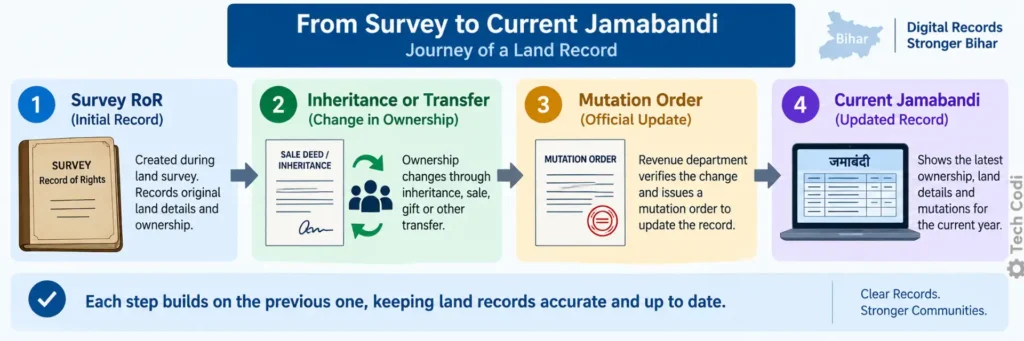
RoR reflects rights and parcel information recorded during a survey. Jamabandi is a continuing revenue account that may be updated after mutation. A registered sale deed records a transfer transaction. Each document serves a different purpose, and none should be expected to replace the other.
For example, an old khatiyan may name a grandfather, the current Jamabandi may name an heir, and a recent deed may name a buyer. The real question is whether the inheritance, partition, transfer deeds, and mutation orders form a consistent chain.
When an RoR copy is useful
An RoR can help trace historical rights, confirm survey identity, compare a plot with the cadastral map, and support a mutation or correction request. It can also expose a mismatch in plot number, classification, or recorded area that deserves further investigation.
For formal use, confirm whether the receiving authority requires a certified copy or digitally signed record. A screenshot or ordinary download may be sufficient for personal comparison but not for a legal or administrative proceeding.
What to do when records disagree
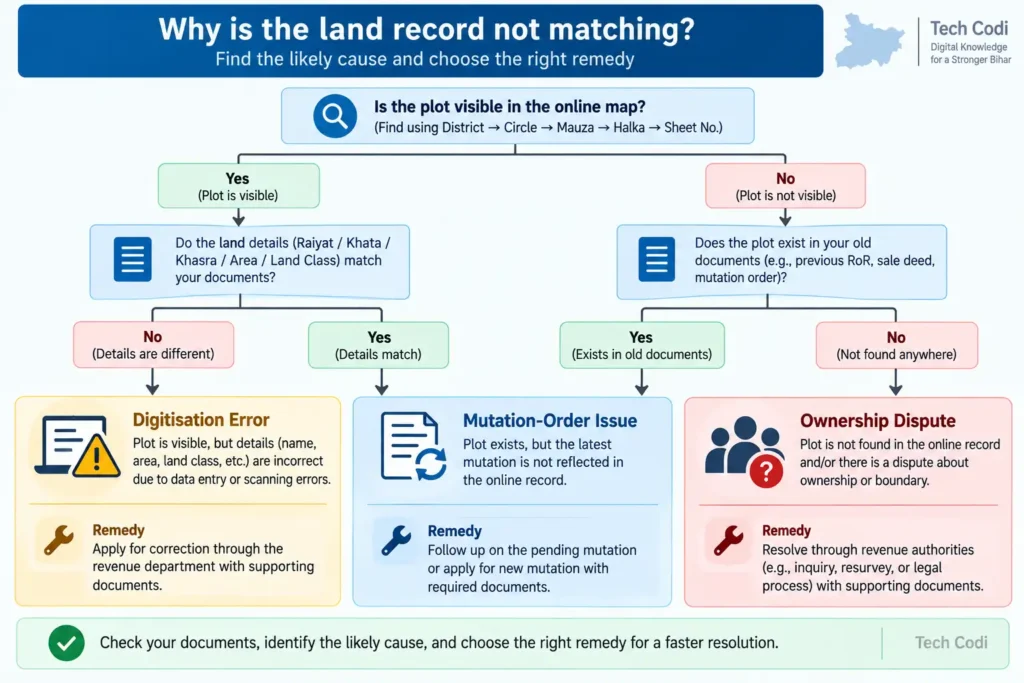
Do not label one record “wrong” until you compare dates and purposes. Place the survey record, deed chain, inheritance documents, mutation orders, Jamabandi, and map in chronological order. A digitisation error may be corrected administratively, while a competing ownership claim may require an appeal, revenue proceeding, or civil remedy.
What does RoR mean in Bihar land records?
RoR means Record of Rights. In Bihar, khatiyan is the survey-based record most commonly associated with the term.
Does RoR always show the present owner?
No. It reflects the position recorded during the relevant survey. Later sale, inheritance, partition, acquisition, and mutation records must also be checked.
What details are usually recorded in RoR?
It may include the raiyat’s name, khata, khasra, area, land classification, rent assessment, survey identifiers, and relevant remarks.
How is RoR different from Jamabandi?
RoR is generally survey-based, while Jamabandi is a continuing revenue account that can be updated after mutation and accepted changes.
Where can I get an RoR that is not available online?
Ask the relevant circle office, district record room, or survey office about record inspection and certified-copy procedures.
Can an error in RoR be corrected through Parimarjan Plus?
Not every RoR or survey issue falls under Parimarjan Plus. The remedy depends on whether the problem is a digitisation error, survey objection, mutation issue, or ownership dispute.
बिहार भूमि की महत्वपूर्ण आधिकारिक सेवाएं
बिहार सरकार की भूमि एवं राजस्व सेवाओं के आधिकारिक लिंक एक ही जगह