Land mutation is the process of recording a recognised change in the revenue account. In Bihar it is commonly called dakhil kharij: the relevant area is removed from the previous raiyat’s entry and entered in the name of the accepted new raiyat after the case is approved.
Mutation usually follows a registered sale, gift, succession, partition, will, court order, or another legally recognised basis. Registration and mutation are connected but separate. A registered deed does not automatically guarantee that every revenue entry has been checked and updated correctly.
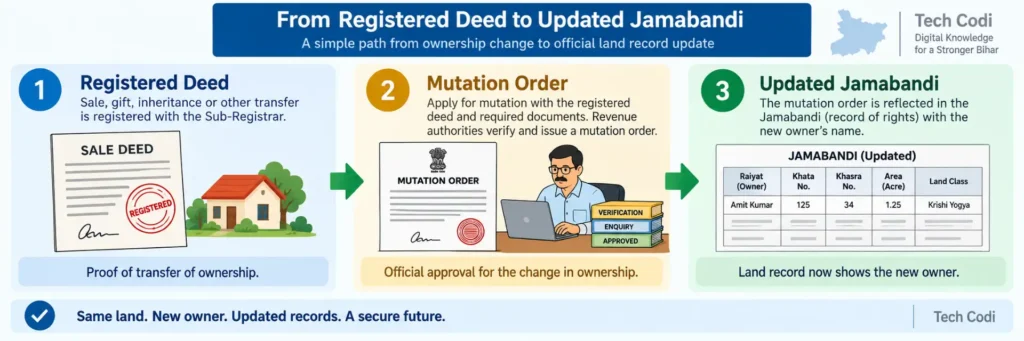
Mutation and ownership are not identical
Mutation is an administrative revenue process. It records a change for land-revenue purposes and supports later services, but it does not by itself settle every disputed question of title. Ownership may depend on the registered deed chain, inheritance, valid partition, possession, court orders, and other facts.
This is why a buyer should not rely only on a mutation receipt, and a seller should not rely only on an old Jamabandi. A safer review combines the deed, survey record, current Jamabandi, mutation order, map, and possession.
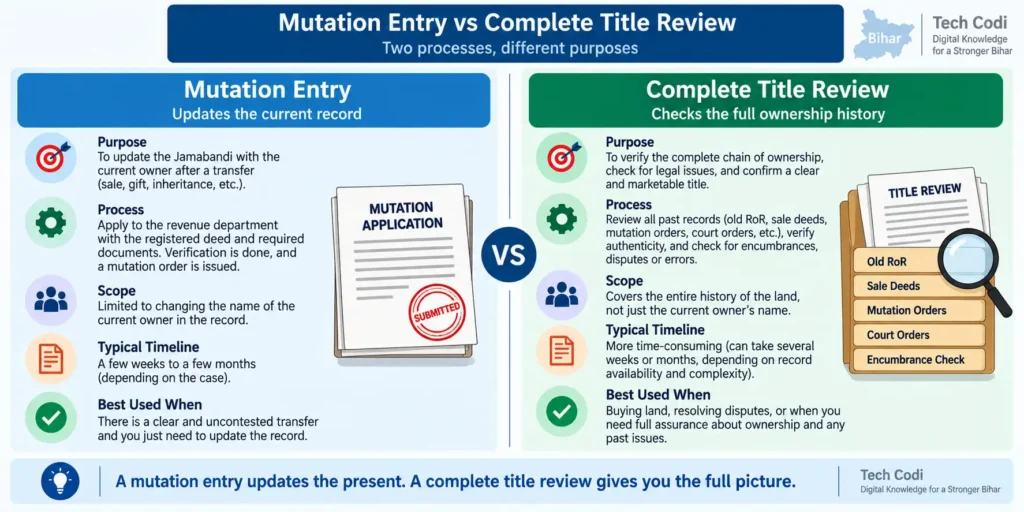
When should mutation be applied for?
Apply after acquiring a recognised interest through sale, succession, gift, partition, will, decree, or another permitted event. The official Bihar mutation FAQ states that if the petition is not filed within 90 days of acquiring the right, a delay-condonation petition must accompany it and the Circle Officer will decide it on merits.
Before applying, verify that the seller or previous raiyat’s online Jamabandi contains the relevant khata, khasra, and sufficient area. If the base entry is missing or materially incorrect, the application can face difficulty until the appropriate correction or digitisation route is completed.
Why mutation is important
An approved mutation helps align the revenue account with the accepted transaction or succession. It supports future land-rent payment, Jamabandi search, LPC-related work, and later transactions. Leaving several transfers unmutated can make the documentary chain harder to explain when the land is sold, inherited, or partitioned again.
Mutation also creates a process in which reports, notice, objections, and a reasoned order may be considered. It gives affected parties an opportunity to object instead of changing the online entry solely on the strength of a form submission.
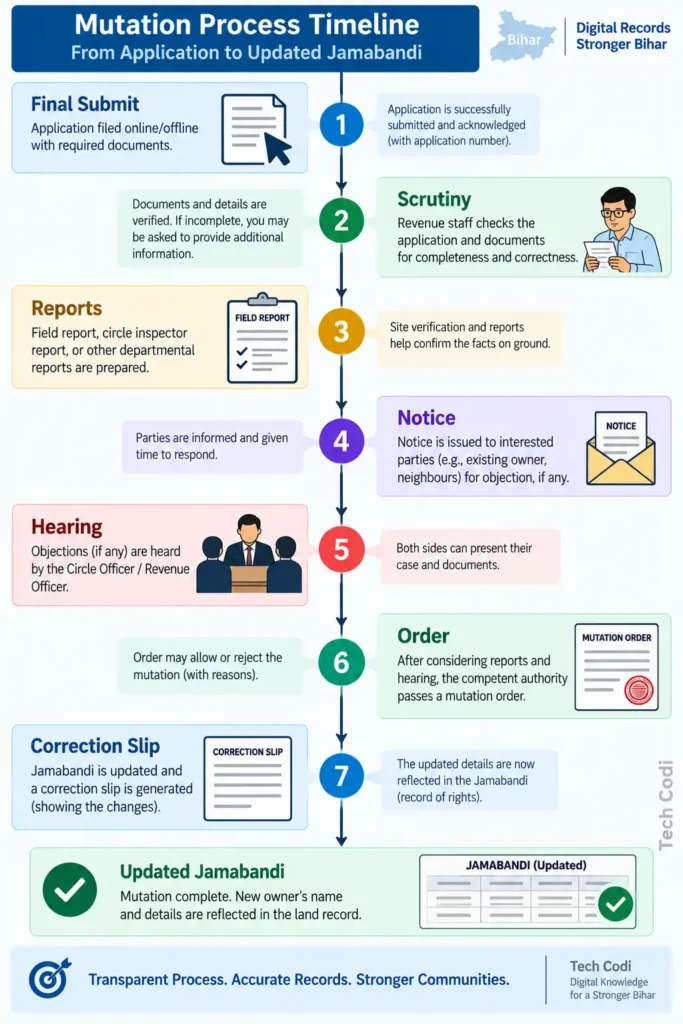
Typical stages in a Mutation Bihar case
- The applicant completes and finally submits the online application.
- The application is scrutinised for errors and missing documents.
- If accepted at scrutiny, a mutation case number is generated.
- The revenue employee records a report, including plot-level verification where required.
- The revenue officer examines the report and records a recommendation.
- General and specific notice is issued; the official FAQ describes a 14-day objection period.
- If an objection is filed, the parties may be heard.
- The Circle Officer passes an order.
- On approval, a correction slip is issued and the Jamabandi is updated through the prescribed process.
If the case remains pending
Read the detailed status instead of relying on the word “pending.” The case may be awaiting a field report, revenue-officer recommendation, notice period, objection hearing, or final order. Keep the token and case number separate, because the token-level defect service and case-status service serve different stages.
If the application is returned during scrutiny, correct the stated defect through the applicant login where the portal permits resubmission. If a final adverse order is passed, read the order before deciding between a fresh application and an appeal.
What to check after approval
Download or obtain the final order and correction slip. After allowing time for the system to update, search the Jamabandi again and verify the new raiyat, khata, khasra, and area. An approval screenshot is not a substitute for checking the resulting revenue entry.
FAQs
What is mutation of land in Bihar?
It is the revenue process for recording an accepted change after sale, inheritance, gift, partition, will, court order, or another recognised basis.
Does mutation create ownership?
Mutation is important revenue evidence, but it does not independently settle every title dispute. The underlying deed, succession, partition, possession, and orders must also be examined.
Is online mutation in Bihar free?
The official Bihar mutation FAQ states that mutation is free. Be cautious if an unofficial operator describes a private service charge as a government fee.
What happens if I apply after 90 days?
According to the official FAQ, a delay-condonation petition must be attached when the mutation petition is not filed within 90 days, and the Circle Officer decides it on merits.
Why is the seller’s Jamabandi important?
The relevant plot and sufficient area generally need to be available in the previous raiyat’s online entry so that the accepted area can be removed and entered for the new raiyat.
What should I do after mutation is approved?
Save the order and correction slip, then verify that the updated Jamabandi correctly shows the new raiyat, khata, khasra, and area.
बिहार भूमि की महत्वपूर्ण आधिकारिक सेवाएं
बिहार सरकार की भूमि एवं राजस्व सेवाओं के आधिकारिक लिंक एक ही जगह